
Ayisha Siddiqi
The Eloquence of Resistance
By Tia Holder
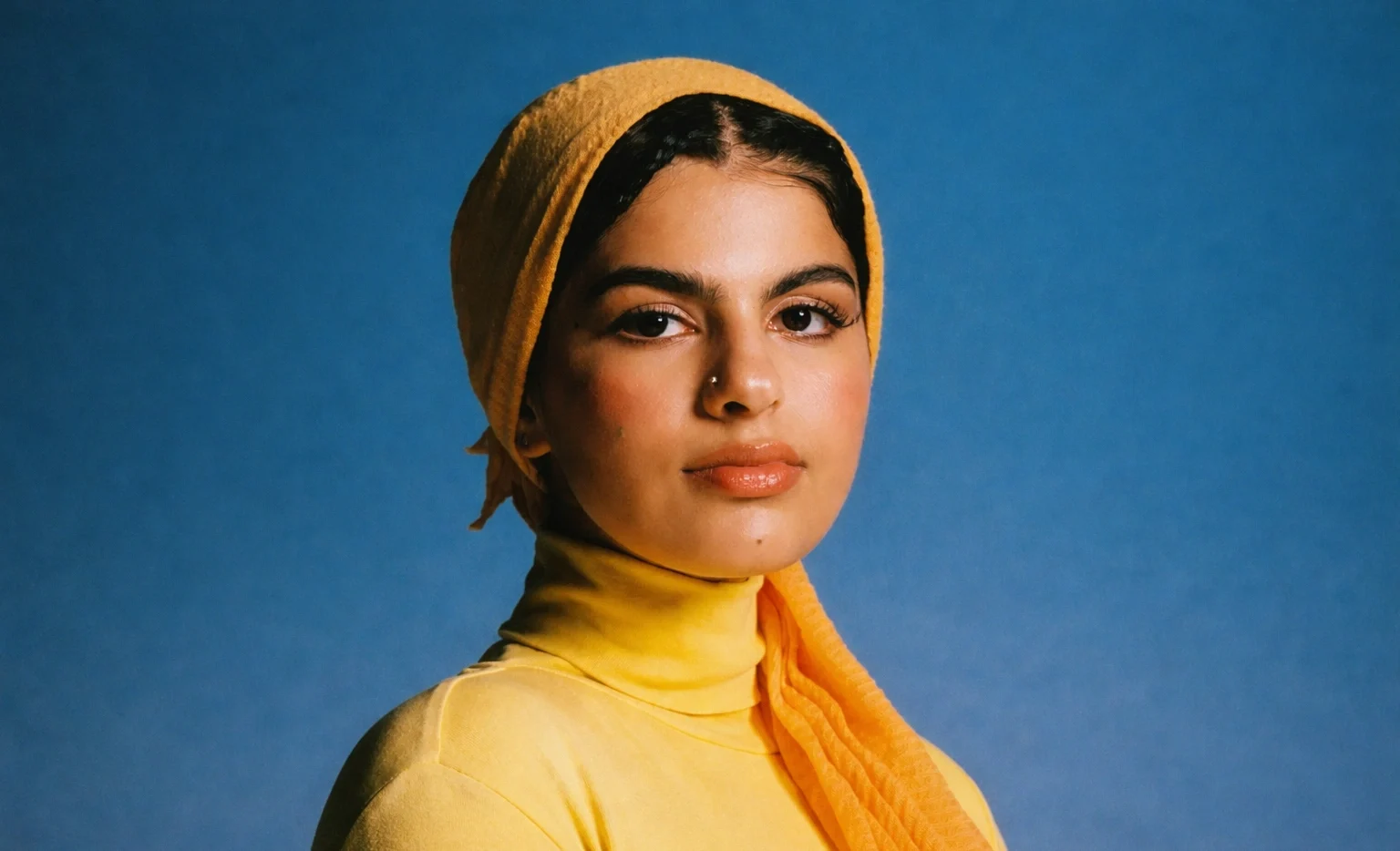
In the vast and often sterile corridors of international diplomacy, where the language of crisis is frequently reduced to the cold mathematics of carbon and commerce, there is a voice that sounds like the earth itself. It is a voice that carries the silt of the Chenab River and the salt of the shoreline, a bridge between a childhood in the tribal lands of Pakistan and a youth spent on the front lines of global advocacy. Ayisha Siddiqa does not simply speak to power; she addresses it with a lyrical ferocity that demands a reckoning with the human soul. She has become a figure of singular importance, a woman who has realised that while policy may move the hand, only poetry can move the heart.
Her story is one of profound observation, beginning in the agricultural heartlands of Jhang. There, amongst the rhythms of her grandparents’ farm, she first understood the earth as a living, breathing entity, a matriarchal provider to whom we owe an eternal debt. This was not an abstract environmentalism learned from a textbook, but a lived reality. When that reality was fractured by the arrival of illness and the haunting silence of a polluted river, the realisation was stark and life-altering. By the age of fourteen, she had seen the direct consequences of environmental neglect, witnessing how the degradation of the land is inextricably linked to the violation of human rights. This early awakening forged a defender who views the protection of the planet not as a choice, but as an ancestral duty.
Moving to the vibrant, chaotic energy of New York did not dim these memories; it sharpened them. As she navigated the academic rigours of political science and English, she began to weave her experiences into a formidable tapestry of activism. She emerged as a leader who could mobilise hundreds of thousands on the streets of Manhattan while simultaneously interrogating the legal frameworks of climate litigation. Her work is a constant defiance of silos, a refusal to separate the suffering of the Global South from the consumption of the Global North. She stands as a reminder that the climate crisis is not a future threat to be managed, but a current apocalypse being endured by those whose voices are too often muffled by the din of industry.
There is a quiet, magisterial authority in the way she occupies spaces traditionally reserved for the elder statesmen of the world. As an advisor to global institutions, she brings the unvarnished truth of the frontline to rooms that are often insulated by wealth and privilege. She has been instrumental in the creation of movements that seek to strip away the influence of polluters from the very forums meant to solve the crisis. Her co-founding of initiatives aimed at transparency and education was born from a desire for accountability and a demand for a seat at the table that is not bought by the highest bidder. She represents a generation that has grown tired of incrementalism and is instead reaching for a radical, restorative justice.
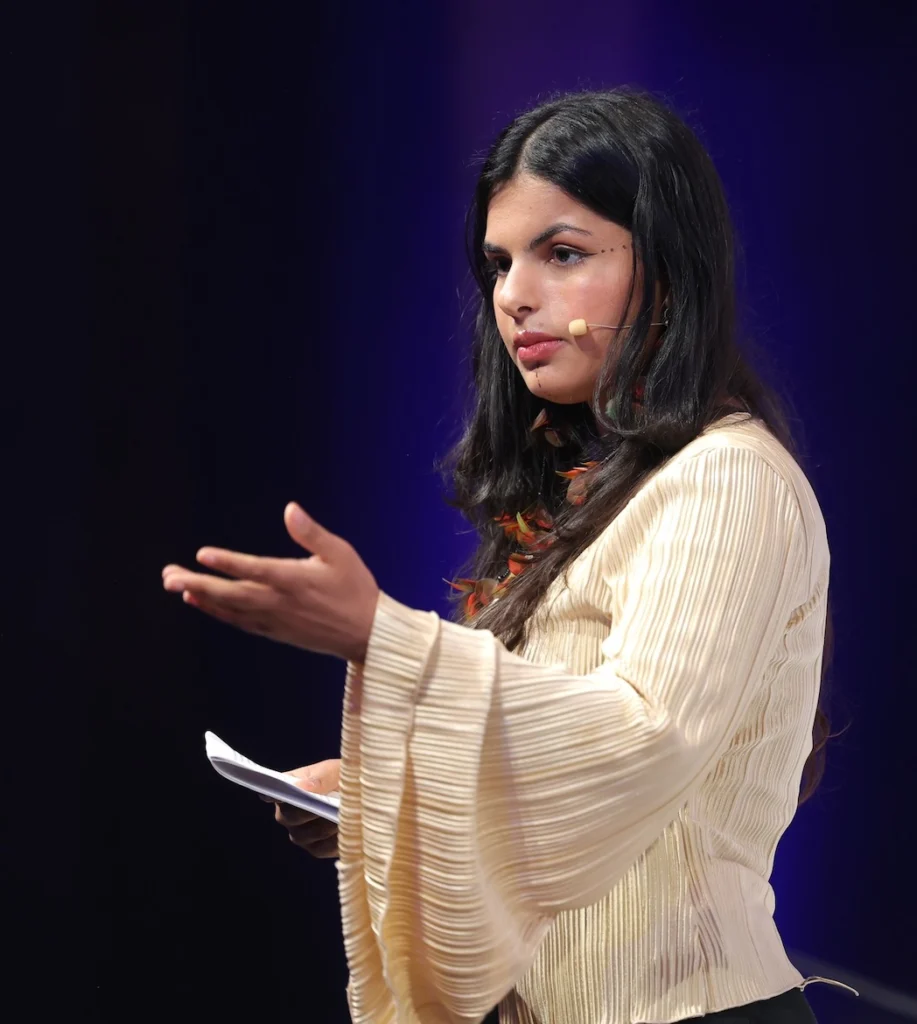

Perhaps her most potent weapon is her command of the written word. To hear her read her poetry is to witness a form of alchemy, where the pain of displacement and the grief of loss are transformed into a call for collective courage. She has famously told the gathered leaders of the world that while they spoke of sustainability, her people were dying, a rebuke that stripped away the veneer of diplomatic politesse. For her, art is not an ornament but a primary tool of protest. It is the means by which she preserves the history of her community and the beauty of a wounded world. In her verses, the environment is never a mere backdrop; it is a character, a victim, and ultimately, a source of resilience.
This resilience is deeply rooted in her identity as a woman from a tribal community, where the structures of care and the protection of life are paramount. She has often spoken of how the same systems that exploit the earth are those that marginalise women and girls, creating a powerful intersectional lens through which she views the struggle. Her advocacy is a defence of life in its most essential forms, from the safety of drinking water to the sanctity of the land itself. By elevating these stories, she forces the world to see the faces behind the statistics, making the distant impacts of a warming planet feel immediate and intimate.
In the years since she was recognised as a leading global voice for change, her influence has only deepened. She remains an iconoclast who is unimpressed by the hollow machinery of corporate promises, choosing instead to invest her energy in the youth who will inherit the consequences of today’s indecision. Her work is intergenerational, a bridge of knowledge that ensures the fire of advocacy is passed to those coming after her. She moves between the roles of research scholar, activist, and poet with a seamless grace, always guided by the conviction that we are all part of a collective global destiny.

The brilliance of her presence lies in her refusal to succumb to the paralysis of despair. Despite the apocalypses she has witnessed, her message remains one of a fierce and demanding love. It is a love for humanity that is willing to gamble on our better nature, a love that insists on the possibility of a softer, more beautiful future. She stands as a beacon for those who feel forgotten by the march of progress, a woman who has found her power not in the pursuit of fame, but in the unwavering defence of her people and her planet. In the end, she reminds us that to fight for the earth is to fight for ourselves, and that the most enduring revolution is one built on a promise to the leaves and a commitment to life.